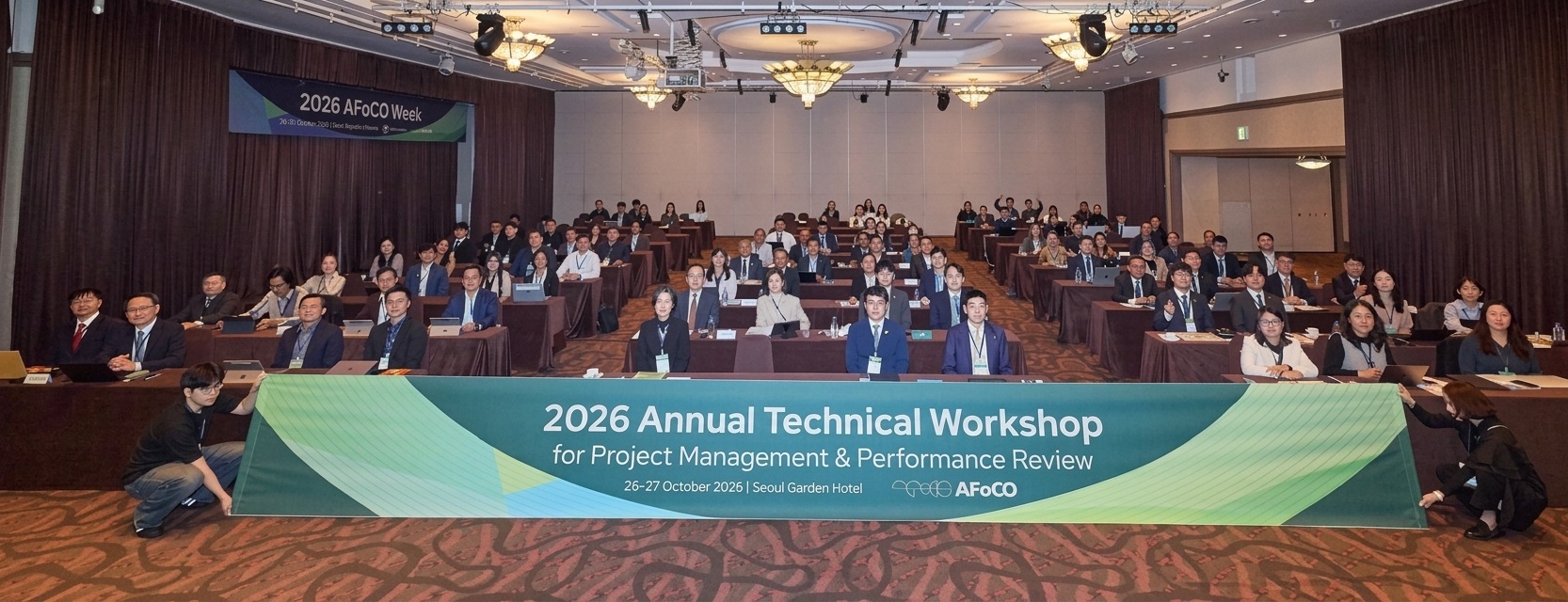

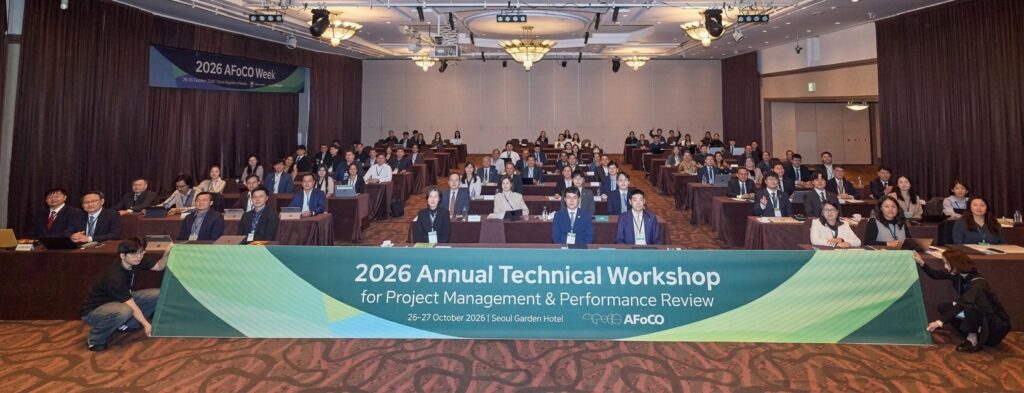
The Global Carbon Council (GCC) has partnered with the Green Climate Fund (GCF) during the 2026 Annual Technical Workshop hosted by the Asian Forest Cooperation Organization (AFoCO) on 26-27 October in Seoul, South Korea.
This provided an opportunity to share how forest restoration projects throughout Asia can access climate finance and take advantage of carbon market opportunities. The GCC’s NbS Certification Framework, new carbon methodologies and digital MRV were presented to demonstrate how they can help projects to enter the voluntary carbon markets and the Article 6 mechanisms.
The event brought together AFoCO’s 15 member countries, international organisations and research institutions. 26 forest cooperation projects were presented, 18 of which were funded by the Korea Forest Service’s ODA programme.
AFoCO is looking to diversify funding sources for sustainable forest restoration projects by using grant funding from the Korea Forest Service, GCF climate funding and generating income from new carbon market opportunities. Accrediting AFoCO as a GCF Accredited Entity in 2026 has also provided new opportunities.
The partnership with GCF and GCC brings complementary skills to the table – GCF have expertise in climate funding and GCC have experience in carbon markets. This partnership follows a Memorandum of Understanding signed with AFoCO in January 2026 to boost the creation of high integrity forest carbon projects across Asia.
Dr Yousef Alhorr, Founding Chairman of GCC, said:
“Asia’s forest sector offers huge potential however it requires robust methodologies, accurate monitoring and transparent carbon market processes. By partnering with AFoCO and acting as a Technical Partner at this event we are looking to bridge forest restoration projects with high integrity carbon market opportunities. This will unlock new investments, ensure long term conservation and offer tangible benefits to local communities.”
Dr Sue Kyoung Lee, Associate Director of Nature-based Solutions at GCC gave a presentation titled ‘From Forest Cooperation to Carbon Credits’. This outlined the new Afforestation, Reforestation & Revegetation method (GCCMA004) and how this offers certification solutions for small holder forestry, agroforestry, dry land restoration and large scale reforestation projects.
An important point of discussion was the GCC’s digital Measurement, Reporting and Verification (dMRV). This uses satellite, remote sensing, field data and uncertainty analysis to provide accurate and transparent carbon accounting. It reduces monitoring costs and enables ongoing assessment of forest status.
Mr Soumik Biswas, Senior Manager of Methodologies & Nature-based Solutions at GCC also presented the NbS Certification Framework. This outlined the process of carbon projects from validation, registration, monitoring, verification and issuance. There was also discussion about how agriculture can be decarbonised including reducing methane emissions from rice through AWD.
GCC launched their new digital GCC 2.0 Registry to provide a systematic and transparent way of managing project data.
Dr Beira Leimona, Theme Leader of Climate Change, Energy & Low Carbon Development at CIFOR-ICRAF gave a presentation outlining the new Mangrove Restoration Methodology. This is being developed with GCC and focuses on site assessment using satellite imagery, ecological restoration, accurate carbon accounting and protecting biodiversity. It also considers fair benefit sharing within local communities.
This builds on the collaborative relationship GCC has with CIFOR-ICRAF to develop a digital MRV.
Internationally Transferred Mitigation Outcomes (ITMOs) under Article 6.2 of the Paris Agreement were also discussed to show how this can help with international carbon trading. Topics such as authorisation by the host country, Corresponding Adjustments and transparent carbon trading were discussed.
This shows how AFoCO member countries can enter into international carbon markets while still ensuring environmental integrity and meeting Article 6 criteria.
GCC will continue to support forest carbon projects in Asia through its partnership with AFoCO & CIFOR-ICRAF. This includes developing robust methodologies, improving digital monitoring and promoting transparent carbon certification.
This will help long term forest restoration by combining international climate funding and carbon market investment. New opportunities can be unlocked and tangible environmental and economic benefits offered to local communities.