

Qatar’s IT and IoT landscape is expanding rapidly, driven by the national Qatar National Vision 2030 and Digital Agenda 2030 initiatives. Digital investments targeting artificial intelligence (AI), Internet of Things (IoT), and cybersecurity are projected to reach US$5.7 billion (QR20.75 billion). A Business Leaders ME analysis.
The latest and most critical updates shaping Qatar’s technology sector feature major milestones in telecom infrastructure, public cloud autonomy, and smart city deployments.
Thinktanks have segmented the IoT market by component (hardware, software, and services), connectivity technology (5G SA/Private 5G, NB-IoT/LTE-M, and more), application (smart manufacturing, smart city and infrastructure, and more), and end-user vertical (manufacturing, transport and logistics, and more).
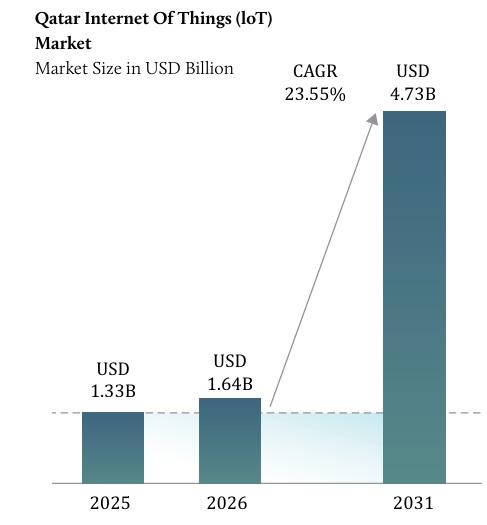
According to Mordor Intelligence, the Qatar IoT market size is expected to grow from US$1.33 billion (QR4.8 billion) in 2025 to US$1.64 billion (QR5.9 billion) in 2026 and is forecast to reach US$4.73 billion (QR17.2 billion) by 2031 at 23.55 percent CAGR over 2026-31.
Persistent public-sector digitalisation under the Tasmu Smart Qatar programme, a nationwide 5G footprint, and large-scale liquefied natural gas (LNG) industrial upgrades keep capital expenditure on connected devices elevated. Continuous infrastructure investments – including a US$22.2 billion (QR80.8 billion) five-year plan that prioritises smart water management – create further demand for sensor networks. Ultra-high 5G median down-load speeds topping 666 Mbps foster low-latency use cases in autonomous mobility and mission-critical energy operations. At the same time, strict data-sovereignty rules are pushing enterprises toward localised edge-cloud deployments, reinforcing spending on secure IoT platforms. Qatar’s commitment to generate 13,000 technology jobs by 2030 under the National Digital Agenda bolsters a domestic services ecosystem that scales implementations across industries.
TASMU SMART QATAR AND NDA 2030 DIGITAL-GOVERNMENT ROADMAP
Tasmu accelerates e-government, targeting 90 percent service digitalisation by 2030. The initiative has already launched an accelerator that on-boards 25 international start-ups, linking them with ministries for proof-of-concept pilots. Economic models anticipate QR40 billion in gross value added from these projects, amplifying fiscal headroom for connected infrastructure. Inter-agency data exchange creates a baseline demand for secure IoT gateways and analytics platforms that unify diverse sensor feeds. As the programme aligns with the Third National Development Strategy, every ministry mandates interoperability standards that favour open Application Programming Interface (APIs) and modular architectures, further boosting the Qatar IoT market.
NATION-WIDE 5G AND NB-IOT ROLL-OUTS BY OOREDOO AND VODAFONE
Ooredoo commercialised 5G in 2018 and now records peak rates of 35.46 Gbps on 3.5 GHz spectrum, enabling dense device connectivity. Vodafone is modernising its core network with cloud-native software from Nokia, unlocking features such as network slicing for enterprise SLAs. Device density projections exceed 1 million links per square kilometre in Doha’s central districts, catalysing mass-scale sensor roll-outs. Competitive pressure between the two carriers ensures ongoing throughput upgrades, stabilising quality of service for mission-critical verticals. budgets thus shift toward licences, APIs, and maintenance contracts, reinforcing the software grip. Managed services will deliver a 25.3 percent CAGR across 2026–31 as enterprises outsource device lifecycle management, cybersecurity, and cloud hosting. Meanwhile, hardware purchases continue but grow at a slower clip, curbed by standardisation that elongates refresh cycles. Software supremacy springs from Qatar’s data-driven governance model, where ministries seek real-time insights to benchmark public-service KPIs. Projects such as the Scale AI collaboration showcase the pivot toward predictive analytics for queue management and resource allocation. The services boom reflects a move from proof-of-concept to full production, compelling firms to engage integrators with multi-vendor skill sets. Hardware demand stays underpinned by LNG facility build-outs and smart-metre deployments, although bulk procurement agreements keep per-unit margins thin.
SMART-CITY AND FIFA-LEGACY INFRASTRUCTURE DEPLOYMENTS
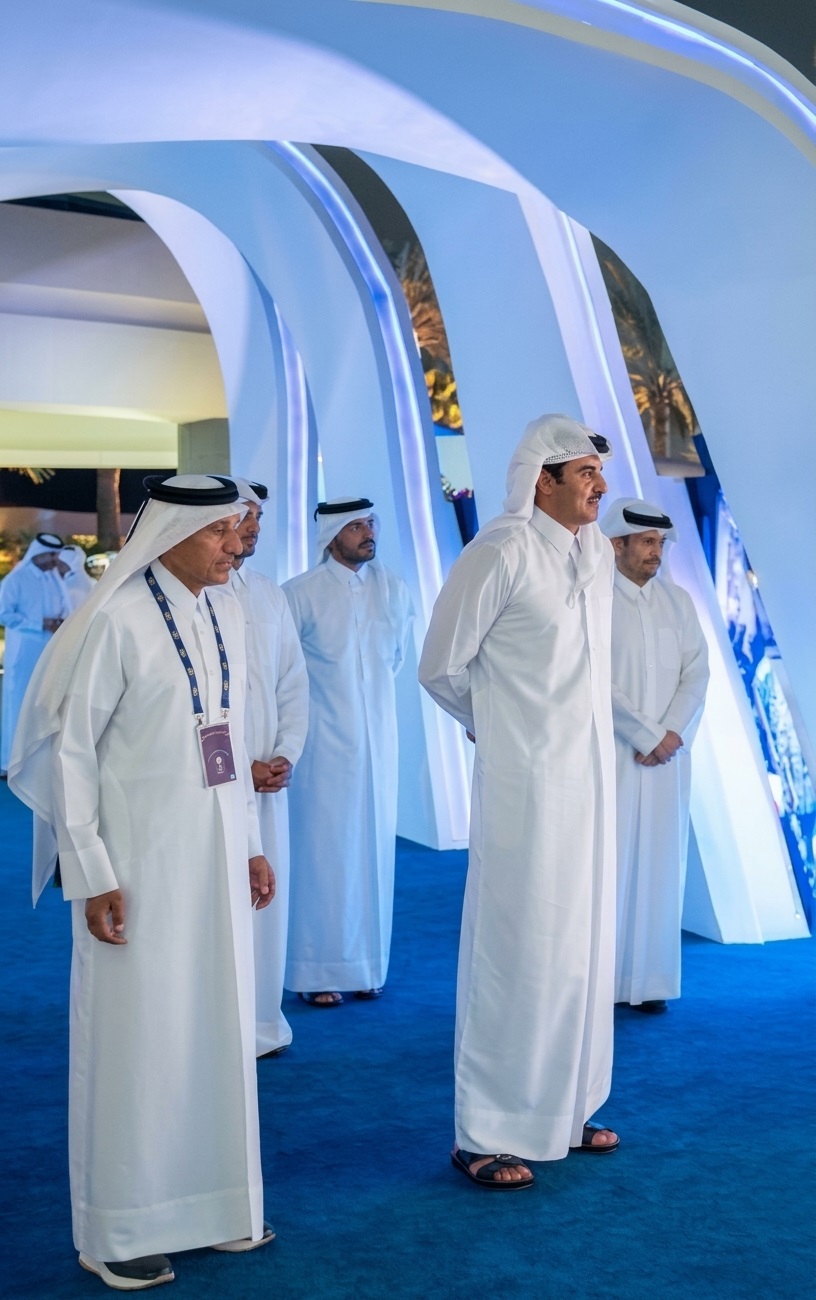
World-Cup venues adopted INTALEQ’s Connected Stadiums Platform that integrates crowd analytics, predictive maintenance, and energy optimisation. Lusail City now runs real-time adaptive signal control across 100 intersections, cutting travel times by 30 percent. Energy City Qatar installed 320 Zigbee-enabled smart poles that reduce street-lighting electricity use by 37 percent. These proven blueprints are replicated in Al Rayyan and Al Wakrah, creating economies of scale for vendors. Stadium IoT assets remain operational for concerts and conferences, ensuring long-term utilisation and revenue streams.
SEGMENT ANALYSIS
By component: Software dominance drives integration: The Qatar IoT market size for software reached US$0.88 billion (QR3.2 billion) in 2025, equal to 66.10 percent of total revenue. Project pipelines for analytics dashboards and AI-enabled orchestration engines remain robust as public agencies demand unified command centres. System optimisation
By connectivity technology: NB-IoT leadership with 5G acceleration: NB-IoT/LTE-M held 40.65 percent of 2025 revenue, anchored by national utility and street-lighting projects. The technology excels in deep indoor coverage and low-power operation, ideal for metering and environmental sensing. The 5G SA/Private 5G slice is the fastest-rising, projected at 25.1 percent CAGR, thanks to industrial mandates for deterministic latency under 10 ms in LNG liquefaction control loops. Wi-Fi 6/7 and bluetooth dominate residential and commercial smart-building niches, while satellite LPWAN supports asset tracking along desert highways. The Qatar IoT market relies on NB-IoT for cost-efficient mass deployment, particularly across 1.2 million electricity and water metres planned before 2029. Ooredoo’s Ericsson mediation upgrade adds billing granularity that translates payload volume into new revenue models. Private 5G proofs at Ras Laffan show 40 percent faster fault-diagnosis versus legacy Wi-Fi. Satellite LPWAN deals with Thuraya extend coverage to pipeline rights-of-way, and Wi-Fi 7 pilots in Doha’s high-rise offices provide sub-2 ms latency for immersive telepresence.
By application: Smart cities lead, manufacturing surges: Smart city and infrastructure deployments generated 37.10 percent of 2025 turnover, confirming Qatar’s status as a global smart-urban lab. Transit optimisation, intelligent lighting, and connected waste-collection top municipal procurement lists. Smart manufacturing will post the highest CAGR at 24.8 percent as factories adopt predictive quality and digital twins to meet export standards. Energy, utilities, connected mobility, and smart homes collectively broaden the use-case matrix and hedge macro-sector risk. Doha’s UNESCO Learning City recognition incentivises further spend on civic technology, from AI parking systems to real-time air-dashboard data, entrenching its first-mover advantage. The smart manufacturing vertical gains traction through QDB’s Factory One accelerator, where 15 SMEs embedded IoT modules that cut defect rates by 22 percent. Connected mobility benefits from Lusail’s multi-modal MaaS platform, recording 50,000 daily micro-mobility trips. Distributed energy resources rely on IoT-enabled smart inverters to balance rooftop solar with grid supply, dovetailing with Kahramaa’s renewable goals.
WORLD-CUP VENUES ADOPTED INTALEQ’S CONNECTED STADIUMS PLATFORM THAT INTEGRATES CROWD ANALYTICS, PREDICTIVE MAINTENANCE, AND ENERGY OPTIMISATION.
INITIATIVES THAT HIGHLIGHT IT AND IOT USAGE
Qatar affirms importance of digital transformation and AI for economic and social development
Qatar affirmed that digital transformation and artificial intelligence have become key drivers of economic and social development, enhancing services, boosting productivity, supporting decision-making, and accelerating progress toward sustainable development.
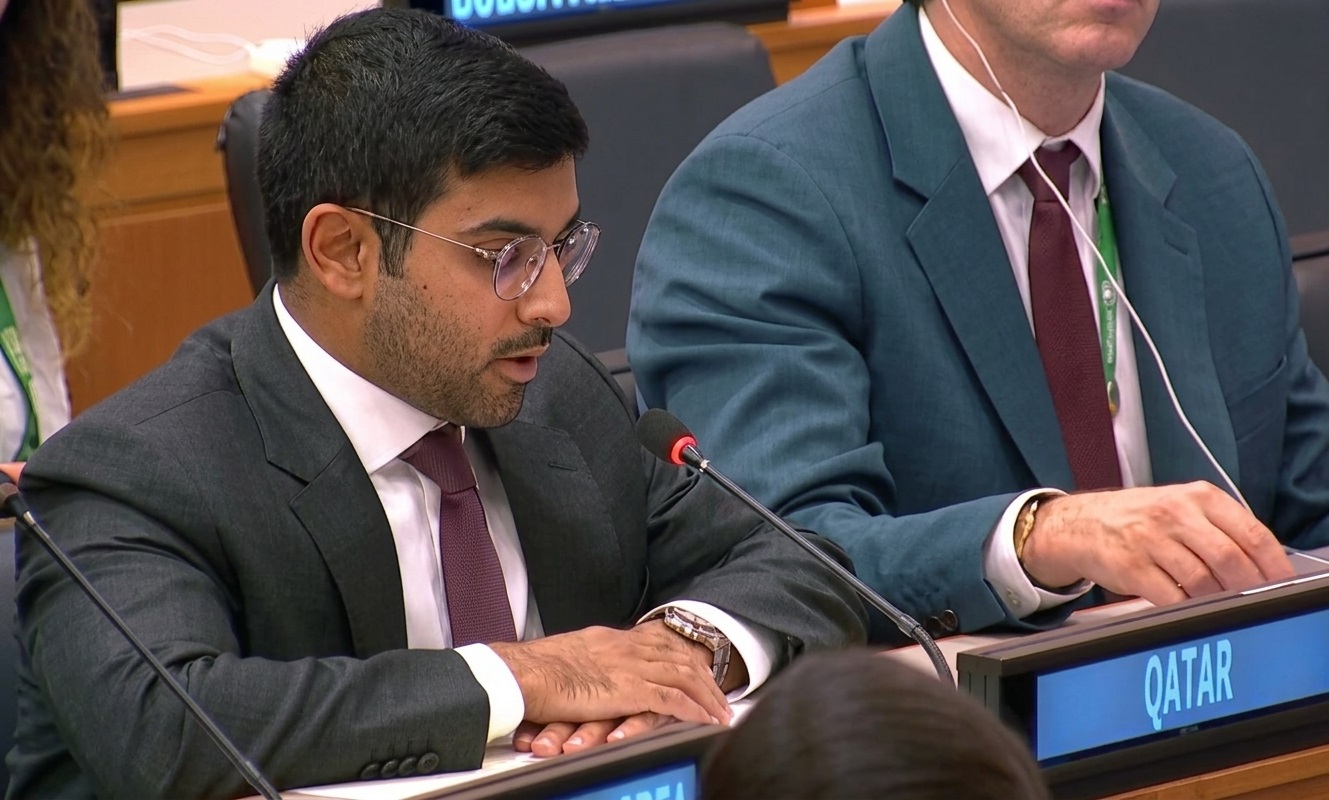
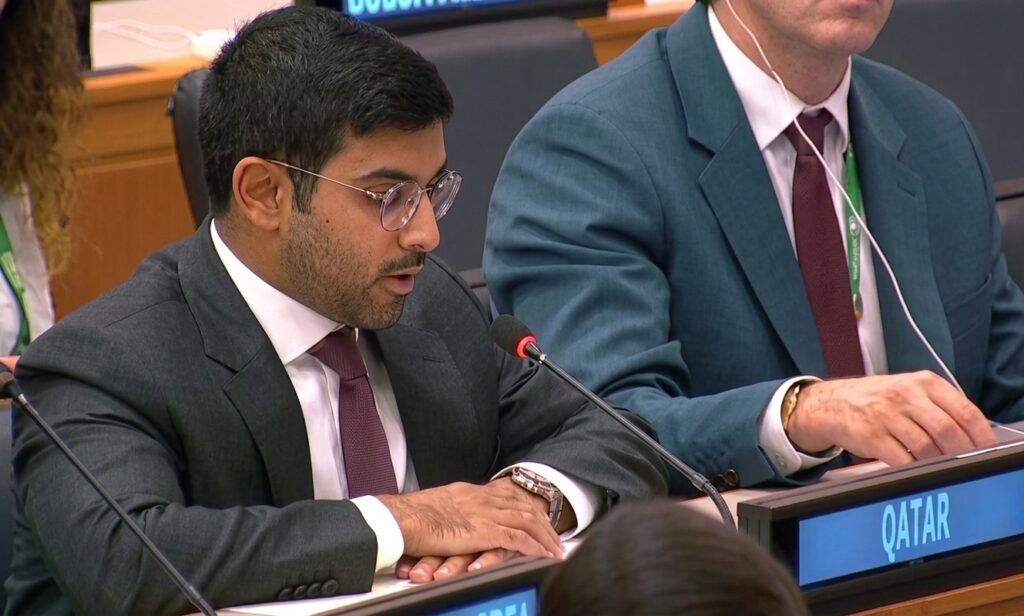
The statement was delivered by member of Qatar’s delegation to the 81st session of the UN General Assembly’s Second Committee Sheikh Khalid Abdulaziz Al Thani, during discussions on Agenda Item 14, Information and Communications Technologies for Sustainable Development, at the United Nations headquarters in New York.
He stated that Qatar attaches great importance to advancing information and communications technology (ICT) and artificial intelligence within the framework of Qatar National Vision 2030 and the Digital Agenda 2030. These initiatives aim to strengthen secure and sustainable digital infrastructure, promote economic diversification, and ensure digital inclusion.
He noted that Qatar is implementing its National Artificial Intelligence Strategy, focusing on promoting scientific research, developing national capabilities, supporting AI applications across various sectors, and fostering partnerships. Initiatives such as GOV AI and Tasmu Smart Qatar programme contribute to accelerating digital transformation and improving the quality of public services.
He also highlighted Qatar’s substantial investment in digital infrastructure to support artificial intelligence, including fibre-optic networks, data centres, and cloud computing capabilities, noting that these investments lay the groundwork for expanding AI applications. In this context, he pointed to Qatar’s announcement in December 2025 of Qai, the national AI company, which aims to invest in infrastructure and advanced AI systems while supporting digital solutions across the public and private sectors.
He added that Qatar recognises the pivotal role of global digital transformation in narrowing development gaps and stressed the importance of international cooperation in technology transfer, capacity building, digital infrastructure development, and ensuring affordable and secure access to technology. Such efforts would help ensure that technology contributes to achieving the Sustainable Development Goals, he said.
Sheikh Khalid Al Thani also highlighted Qatar’s active participation in the UN process on AI governance, including its involvement in the first UN Global Dialogue on AI Governance, held in Geneva in July 2026. He reaffirmed Qatar’s commitment to working with all stakeholders to harness technology and innovation in support of the 2030 Agenda for Sustainable Development.
Meeza and Microsoft launch sovereign private cloud in Qatar
Meeza, a Qatar-based provider of managed IT services and data centres, and Microsoft, have announced plans to bring Microsoft Sovereign Private Cloud to organisations in Qatar with Azure Local as the foundation.
In a press release, the companies said that under the planned service model, Microsoft will provide the Azure Local technology underpinning the environment, while Meeza will provide the Qatar-based data-centre infrastructure, hardware, connectivity, deployment and ongoing managed services.
Through this combination they aim to give customers access to a locally delivered environment, a consistent Azure operating model and a single local service provider to support the full lifecycle of their deployment. It will enable customers to run selected critical, regulated and sensitive workloads on cloud-consistent infrastructure deployed and operated within Qatar.
“By combining Microsoft Azure technology with Meeza’s local infrastructure, connectivity, data centre capabilities, and managed services, we can provide customers with a comprehensive cloud environment delivered and managed locally in Qatar,” Mohamed Ali Al Ghaithani, CEO, Meeza.
Ahmad El Dandachi, country general manager, Microsoft Qatar, said, “Microsoft Sovereign Private Cloud, with Azure Local as its infrastructure foundation, brings Azure capabilities into locally operated environments and gives customers greater control over where their infrastructure, workloads and data reside.”
The offering will support a hybrid-cloud approach, allowing organisations to place workloads in the environment that best matches their operational, security
and regulatory requirements. For government entities, Meeza’s connectivity to Qatar’s government network is planned to provide a dedicated route to eligible Azure Local workloads hosted in Meeza’s data-centre environment without relying on the public internet.
HH the Amir ratifies decision to establish National Center for AI & Digital Capability Development Department
The Ministry of Communications and Information Technology (MCIT) announced on October 19, 2026 the ratification of the Cabinet Decision No. (34) of 2026 establishing the National Center for AI and the Training and Digital Capability Development Department within the Ministry of Communications and Information Technology by His Highness Sheikh Tamim bin Hamad Al Thani, Amir of the State of Qatar.
“In line with the directives of the wise leadership, this administrative reorganisation responds to the rapid developments shaping the information and communications technology sector, particularly in artificial intelligence. It enhances the Ministry’s readiness to keep pace with these changes while supporting the development of regulatory frameworks and policies and strengthening national capabilities”
“The establishment of the National Center for AI represents a strategic step towards unifying and coordinating the State’s efforts in this field, accelerating the adoption of artificial intelligence applications, and strengthening the State of Qatar’s position among the world’s leading digital economies. It also supports the implementation of the Digital Agenda 2030 and the objectives of the Third National Development Strategy”
“Investing in national talent is one of the key pillars of digital transformation. In this context, the establishment of the Training and Digital Capability Development Department will support the design and delivery of specialised training programmes, the development of career pathways and professional certifications, and stronger partnerships with academic and technology institutions. These efforts will help equip national talent with the digital skills required to lead digital transformation, meet the demands of future jobs, and strengthen the competitiveness of the national economy.”
As stated by the Government Communications Office, the objectives of the establishment is to develop national capabilities, accelerate digital adoption, and help build a knowledge-based digital economy.
Ooredoo becomes first operator in Qatar to launch LTE-M for next-generation IoT connectivity
Oredoo has achieved a new milestone in the nation’s digital evolution. Following extensive testing and successful deployment, Ooredoo has become the first operator in Qatar to launch LTE-M (Long Term Evolution for Machines), also known as CAT-M1, a next-generation network technology purpose-built for massive Internet of Things (IoT) applications. This launch reinforces Ooredoo’s commitment to innovation and places Qatar at the forefront of smart connectivity and digital transformation in the region.
LTE-M is a low-power wide-area (LPWA) technology, designed specifically for machine-type communications. It delivers efficient, reliable connectivity for a broad range of smart devices, including sensors, trackers, and wearables, enabling low-power, low-data IoT use cases at scale.
This innovative technology is ideally suited for large-scale IoT deployments, powering applications such as smart city services, smart metering, asset tracking, supply chain management, and security monitoring across key sectors and industries, including transport and logistics, utilities, smart cities, oil & gas, healthcare, banking, industrial safety, and security.
With LTE-M, businesses can deploy smarter and more sustainable IoT solutions thanks to its core features such as:
Extended battery life: upto 10 years for compatible devices;
Deep coverage: reliable connections indoors and underground;
Low latency: enabling near real-time communication; and
Full mobility: ideal for tracking moving assets such as vehicles and shipments.
Together, these capabilities make LTE-M a powerful enabler for scalable, energy-efficient, and future-ready IoT deployments across industries in Qatar.
Hassan Ismail Al Emadi, chief business officer, Ooredoo Qatar has said, “The launch of LTE-M represents another key step in Ooredoo’s journey to drive Qatar’s digital transformation. With LTE-M, we are opening new frontiers of possibility for Qatari businesses. This technology provides the backbone for the next generation of IoT solutions, from smart cities to industrial automation, cementing our position as a digital enabler committed to Qatar National Vision 2030.”
Web Summit Qatar 2026: Msheireb Properties, Ooredoo, Honeywell forge partnership to power next-gen smart city AI-powered platform
Msheireb Properties has announced a key collaboration with Ooredoo Qatar and Honeywell to help automate and manage Msheireb Downtown Doha, one of the world’s most advanced and intelligent smart cities globally.
Unveiled at the Web Summit Qatar event earlier this year, this landmark agreement introduces a pioneering Artificial Intelligence-powered platform designed to help optimise urban operations and enhance the quality of life for all residents and visitors.
Ooredoo has been appointed as the prime partner managing Operations, while Honeywell will customise its City Suite platform to serve as the technology backbone, integrating thousands of sensors from across the city into a single point of control.
The AI-enabled analytics platforms will be designed to integrate operational performance data from the city’s services, while a digital twin of the city infrastructure will enable engineers to model planned updates and reduce system downtime. These elements will be unified into the new AI-powered command centre, enabling live monitoring, predictive maintenance, automated incident management and enhanced operational planning through sophisticated data analytics.
The agreement also includes five years of managed services, helping to ensure that the Msheireb Downtown Doha Smart City platform continues to evolve. This long-term collaboration, aligned with Qatar National Vision 2030, supports the country’s emergence as a global hub for digital transformation and sustainable urban innovation
Commenting on the signing, Eng. Faisal Al Malki, Msheireb Properties chief operating officer, said: “This agreement advances our Smart City ecosystem and enhances how we manage and operate Msheireb Downtown Doha. The platform introduces new digital capabilities that improve efficiency, strengthen service quality, and support sustainable living. Moreover, this partnership contributes to our district’s evolution in intelligent urban living, enabling technologies that offer tangible benefits to those who live, work, and visit here.”
MARKET OPPORTUNITIES AND FUTURE OUTLOOK
A near-term opportunity is in security-first, operator-packaged IoT that reduces deployment friction for enterprises working under data-sovereignty and assurance requirements. Ooredoo’s May 2026 launch of IoT SecureConnect (Zero Trust for IoT devices) highlights demand for bundled device identity, posture checks, and policy enforcement, creating whitespace for providers that can combine connectivity, device lifecycle management, and compliance-aligned security validation for government, utilities, and industrial accounts.
At the solution level, smart-city scale deployments and LPWAN expansion continue to open addressable use cases for asset tracking, facilities optimisation, and metering. The February 2026 partnership between Ooredoo Qatar and Msheireb Properties to integrate more than 650,000 IoT sensors into Msheireb Downtown Doha shows how sensor networks and analytics platforms are moving into large-scale operations, while Ooredoo’s April 2026 LTE-M commercial launch supports massive IoT roll-outs that need low-power wide-area coverage. These actions reinforce opportunities for localised edge analytics, Arabic-localised dashboards, and multi-vendor integration services that align with CRA technical approval requirements and MCIT-led interoperability direction.

Software supremacy springs from Qatar’s data-driven governance model, where ministries seek real-time insights to benchmark public-service KPIs. Projects such as the Scale AI collaboration showcase the pivot toward predictive analytics for queue management and resource allocation. The services boom reflects a move from proof-of-concept to full production, compelling firms to engage integrators with multi-vendor skill sets. Hardware demand stays underpinned by LNG facility build-outs and smart- metre deployments, although bulk procurement agreements keep per-unit margins thin.
THE HURDLES
Shortage of local IoT-cybersecurity and AI talent pool: Sixty-one percent of CIOs cite skills gaps in cloud and machine learning as a primary obstacle to scaled roll-outs. Expatriates fill 95 percent of ICT roles, but visa renewals every two years trigger attrition that erodes institutional memory. Monthly salaries exceeding QR45,000 for senior architects are competitive in the Gulf yet still trail packages in North America, causing outbound migration. Qatar has earmarked 13,000 new digital jobs by 2030; however, university enrolment in data science remains modest. The National Cyber Security Academy’s bootcamps will help, but the near-term pipeline stays thin.
Data-sovereignty and cybersecurity compliance hurdles: The Personal Data Privacy Protection Law requires local hosting for sensitive datasets, raising capital costs for small integrators. A US$150,000 (QR546,000) fine levied on a QFC-licensed fintech for breach reporting delays underscores enforcement vigour. The National Information Assurance Standard obliges rigorous pen-testing and encryption audits before go-live, extending project timelines. AI-enabled IoT systems must also conform to emerging ethics rules, complicating algorithm.
TASMU ACCELERATES E-GOVERNMENT, TARGETING 90 PERCENT SERVICE DIGITALISATION BY 2030. THE INITIATIVE HAS ALREADY LAUNCHED AN ACCELERATOR THAT ON-BOARDS 25 INTERNATIONAL START-UPS, LINKING THEM WITH MINISTRIES FOR PROOF-OF-CONCEPT PILOTS.