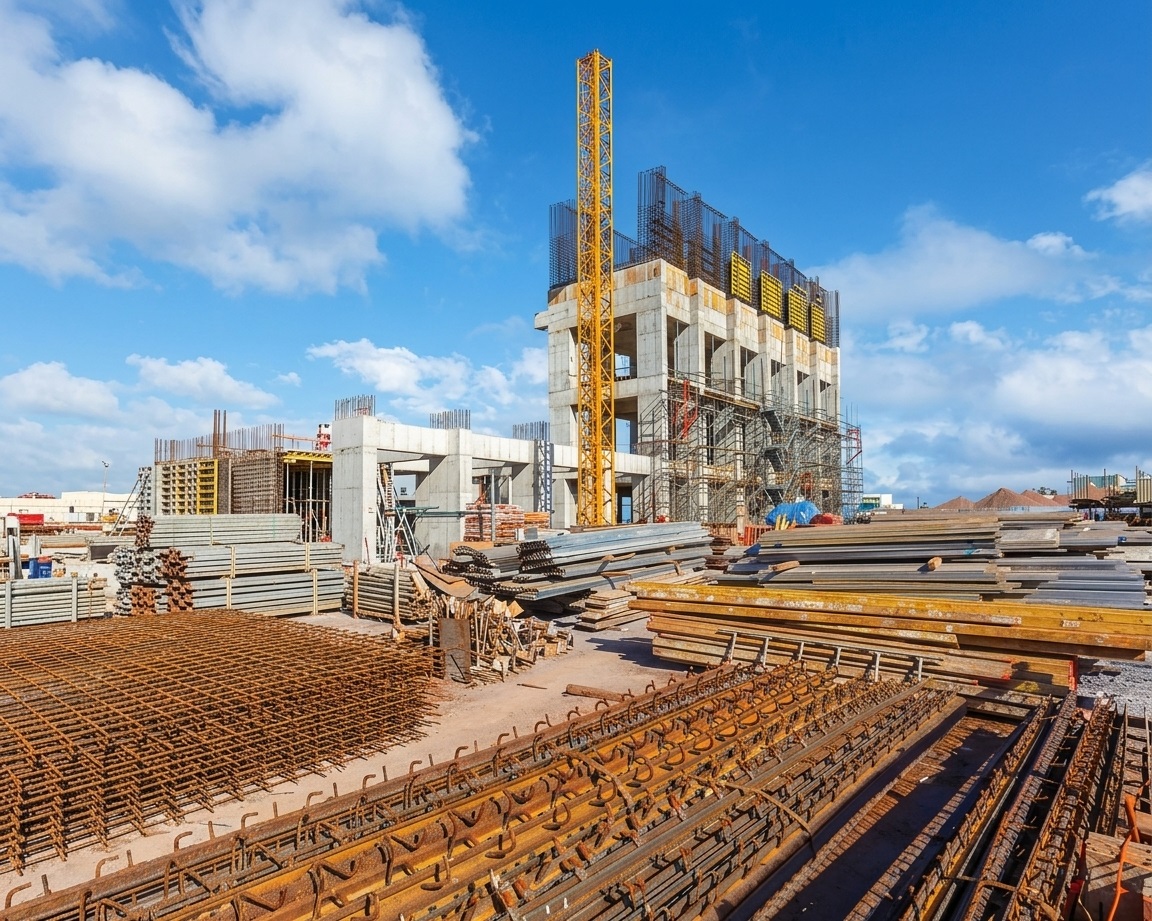

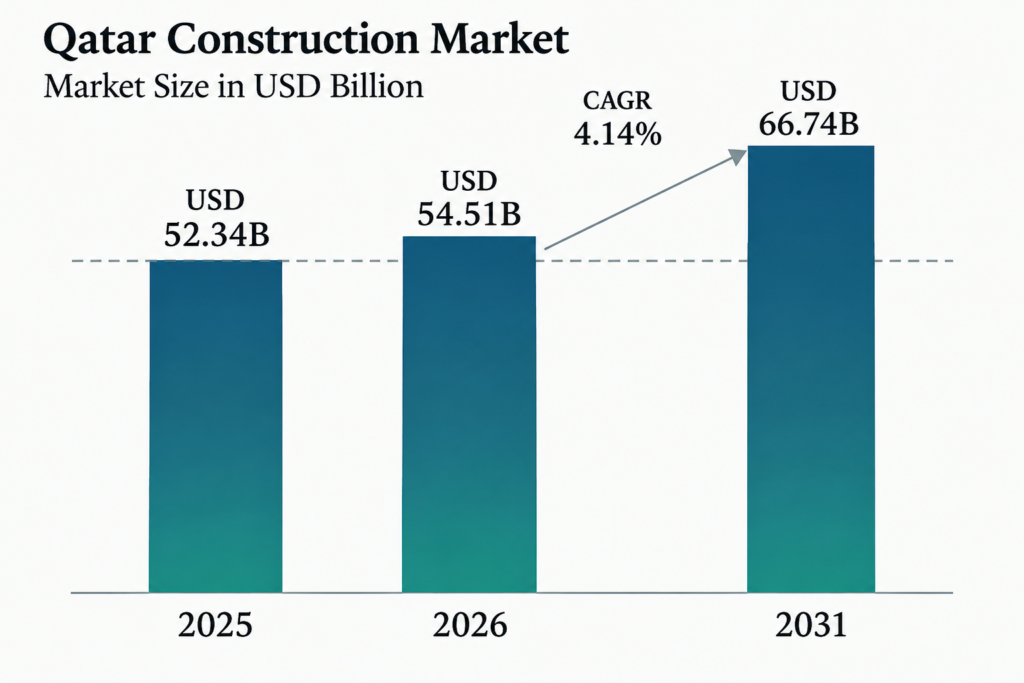
Qatar’s real estate and construction sectors are expanding steadily in 2026, backed by economic diversification under the Qatar National Vision 2030. In terms of construction output, the sector reached an estimated US$54.51 billion (QR198.42 billion) in 2026 with a 4.4 percent to 5.2 percent real-term growth rate. In terms of transactions, the first-half figures surpassed QR10.69 billion, reflecting resilient investor confidence. Long-term forecasts of the construction market is projected to climb to US$66.74 billion (QR242.92 billion) by 2031.
Qatar’s construction industry to expand by 5.2 percent in real terms in 2026, supported by private investments in renewable energy, hospitality and transportation infrastructure. According to the Planning and Statistics Authority (PSA), Qatar’s construction industry value-add grew by 9.1 percent year-on-year (YoY) in Q3 2025, preceded by YoY growth of 8.7 percent in Q2 and 4.4 percent in Q1 2025. Recently, in December 2025, Sheikh Tamim bin Hamad Al Thani, the Amir of the State of Qatar, approved the general budget for the 2026 fiscal year (from January 1, 2026 to December 31, 2026), which is expected to boost investments in educational, healthcare and transport projects
The budget includes an estimated total government expenditure of QR220.8 billion (US$60.7 billion), up 5 percent from the 2025 budget. On the revenue side, the government projects total revenue of QR199 billion (US$54.7 billion), primarily driven by oil and gas earnings, supported by non-hydrocarbon revenues. Around QR62.8 billion (US$17.3 billion) is allocated to major capital projects, such as
infrastructure, transport, and development initiatives that support long-term economic diversification, reflecting a 5.7 percent increase compared to the QR59.4 billion (US$16.3 billion) allocated in the 2025 budget.
However, recent joint US-Israeli strikes on Iran, starting February 28, 2026, are expected to have a substantial effect on Qatar’s Liquefied natural gas (LNG) exports, presenting a critical threat. As the world’s second-largest LNG exporter, Qatar is expected to face a severe threat if the Strait of Hormuz remains a conflict zone, impacting the country’s economy and public investments in infrastructure development.
Qatar’s construction industry, over the forecast period, is expected to register an annual average growth of 4.5 percent from 2027 to 2030, supported by investments in LNG, renewable energy and transport infrastructure projects. Under the Qatar Ministry of Transport (MoT) Strategy 2025-30, also known as ‘Reaching Beyond Horizons,’ the government of Qatar aims to develop 124 transport infrastructure projects across 42 initiatives by 2030, with an estimated investment of QR1.2 billion (US$329.7 million).
US$300 BILLION (QR1.09 TRILLION) INVESTMENT ON THE BACK OF FIFA 2022 WORLD CUP IN QATAR
STABLE FOOTING
Qatar’s construction and real estate sectors entered 2026 on a stable footing, although the Iran conflict temporarily dampened buyer sentiment and slowed transaction momentum, particularly in discretionary residential and investment-led segments. These segments play a key role in Qatar’s National Vision 2030, the country’s roadmap for economic diversification, according to Oxford Business Group’s analysis.
Despite these geopolitical headwinds, construction is expected to expand moderately in 2026 and 2027, supported by population and tourism growth, alongside government-backed infrastructure projects, LNG expansion projects, renewable energy investment and urban development schemes. Private sector participation has been on the rise and demand remains steady for the refurbishment of infrastructure built for the 2022 FIFA World Cup. Nevertheless, the sector now faces a higher degree of delivery risk with the Iran conflict having disrupted Qatar’s LNG infrastructure, heightening uncertainty across regional shipping routes and input supply chains. While this is unlikely to derail the construction pipeline, the after effects of the conflict may affect some projects.
The real estate market stabilised during 2025, following a slowdown after Qatar’s hosting of the World Cup, with transaction activity gradually returning to more typical levels across key segments. Reflecting this trend, S&P Global Ratings reported in January 2026 that Qatar’s residential property sector was experiencing a moderate recovery.
STRUCTURE AND OVERSIGHT
Qatar’s Public Works Authority (Ashghal) is responsible for the design, management, and delivery of major infrastructure projects, including transport, urban development, and water and waste management. The Ministry of Municipality (formerly the Ministry of Municipality and the Environment) oversees urban planning, land surveys, zoning, building regulations and permitting, and maintains real estate transactions records.
The Real Estate Regulatory Authority (Aqarat) regulates Qatar’s real estate sector, including the licensing of developers, development projects and related companies. The Real Estate Registration Department of the Ministry of Justice administers the legal and transactional framework for property ownership, including online applications for real estate registration and the issuance of title deeds.
“TO MEET RISING DEMAND, THE NUMBER OF HOTEL ROOMS ACROSS QATAR IS SET TO INCREASE TO 45,569 BY 2028, UP FROM 42,555 IN 2025.”
Alongside these regulatory bodies, Qatari Diar serves as a key government-backed developer and investment vehicle.
CONSTRUCTION PERFORMANCE
In the decade leading up to the 2022 FIFA World Cup, Qatar’s construction sector was driven by approximately US$300 billion (QR1.09 trillion) in investment as the country prepared to host the tournament. Following the competition, investment activity moderated, with the sector’s GDP contribution declining from 13.4 percent in 2021 to 11.3 percent in 2024.
However, signs of renewed growth have emerged. In the first quarter of 2025 the construction sector contributed QR19.2 billion (US$5.3 billion), equivalent to 10.6 percent of GDP, representing year-on-year (y-o-y) growth of 4.4 percent, according to government figures. In the third quarter of 2025, construction was the fastest-growing industry within Qatar’s non-oil economy, expanding by 9.1 percent y-o-y. The construction market is forecast to expand from US$54.5 billion (QR198.4 billion) in 2026 to US$66.7 billion (QR244.8 billion) by 2031, at a compound annual growth rate (CAGR) of 4.1 percent, according to market intelligence firm Mordor Intelligence.
Qatar’s construction sector continues to play a central role in the country’s national development agenda, with sustained growth in buildings and infrastructure supported by both public and private sector participation.
PUBLIC AND PRIVATE SPEND
As part of the government’s 2026 budget, Ashghal plans to issue infrastructure tenders worth QR49 billion (US$13.5 billion). This comes in addition to a series of infrastructure projects valued at QR81 billion (US$22.2 billion), announced in May 2025 as part of the authority’s five-year development plan through 2029. The plan also includes the expansion of public-private partnerships (PPPs), which have delivered over 5500 residential plots. This followed a May 2020 law regulating PPPs, making it easier for international companies to participate in public infrastructure projects, particularly those aligned with Qatar National Vision 2030, such as the building of telecom facilities, hospitals and sewage treatment plants. By 2030, Qatar is expected to award US$85 billion (QR309.4 billion) in PPPs, particularly in large-scale water infrastructure, as well as solar energy projects and storage facilities in free trade zones.
INFRASTRUCTURE CONSTRUCTION
Ongoing large-scale transport projects continue to support the construction sector. In late 2025, Ashghal awarded a QR3.5 billion (US$960.6 million) contract to French engineering firm Egis and its local partners, Qatar Building Company and Waagner Biro Bridge Qatar Association, for the operation and maintenance of more than 2300 km of motorways and roads and 23 tunnels. The second phase of the Doha Metro expansion is scheduled for completion in 2026, while expansion work at Hamad International Airport is ongoing and will increase passenger capacity to more than 65m annually.
Major urban developments, primarily concentrated in and around Doha, are also driving growth in the construction segment. These include the $45billion development of Lusail, a smart city north of Doha. The project’s residential, commercial, hospitality and retail components aim to attract 200,000 residents and 80,000 visitors, while supporting around 170,000 jobs across its 19 districts.
Doha; Lusail City, a waterfront community 15 km north of Doha; and West Bay Lagoon, known for its luxury villas. In Doha, apartment sales recorded 559 transactions worth QR2.2 billion (US$603.83 million), up 43 percent from 2024 to 2025.
In 2025, the average property sale price per square metre in Lusail ranged from QR13,000 (US$3568) to QR15,000 (US$4117) for apartments, while villas in Al Waab and West Bay Lagoon ranged between QR9 million (US$2.5 million) and QR15 million (US$4.1 million). In terms of land prices, Doha recorded the highest with an average land price of QR380 (US$104) per sq ft and Al Shamal reporting the lowest at QR170 (US$46.66) per sq ft, according to KPMG.
COMMERCIAL PROPERTY
Economic diversification aligned with Qatar National Vision 2030 has supported job growth and, in turn, office demand, particularly in the tech, renewable energy and services sectors. There has been a clear shift toward prominent locations, with tenants relocating from older office stock in search of more modern buildings, serviced offices and co-working spaces.
In 2025, Qatar’s office market saw premium rents fall by 1.4 percent, with average rents ending the year at QR90 (US$24.70) per sq metre per month, reflecting a more competitive leasing environment as supply expands. West Bay remains Doha’s primary office centre, with available space has declining to approximately 115,000 sq metres, equivalent to around 6 percent of total supply as of late 2025.
COMMERCE AND HOSPITALITY
Commercial projects accounted for nearly 35 percent of the construction market in 2025, while infrastructure remained the fastest-growing segment. Major office towers and mixed-use projects, such as Lusail’s financial district, lead government efforts to establish Doha as a regional financial leader.
Rising tourism is driving higher hotel demand and supporting growth across the construction, real estate and hospitality sectors. Hotel occupancy rates rose to 69 percent in the third quarter of 2025, up 3.7 percent y-o-y. To meet rising demand, the number of hotel rooms across Qatar is set to increase to 45,569 by 2028, up from 42,555 in 2025.
RESIDENTIAL REAL ESTATE
Qatar’s real estate sector ranks second after hydrocarbons in attracting foreign direct investment. The sector’s contribution to GDP rose from 5.4 percent in 2014 to 7.4 percent in 2024, underscoring its growing importance in the country’s economic diversification goals. In 2025, the total value of home sale transactions rose by 43.5 percent to QR26.6 billion (US$7.3 billion), while the number of transactions increased by 50 percent to 6831, reflecting continued demand in core residential markets.
In 2025, residential sales remained concentrated in Doha’s prime real estate areas such as The Pearl, a development on a large artificial island off the coast of Doha.
MARKET DRIVERS
Qatar’s population is projected to grow by 50 percent, from 2.2 million in 2014 to an estimated 3.3 million in 2029, driving real estate demand. Tourism is also a growth driver, boosted by mega-events and growing hotel supply. Tourist arrivals to Qatar rose to 5.1 million in 2025, up 4 percent from 4.9 million in 2024.
By 2030, Qatar aims to attract 6 million annual visitors. The GCC Unified Tourist Visa, a regional scheme set to launch in late 2026, is also expected to boost tourism and hotel occupancy in Qatar.
At the project level, ongoing mixed-use residential developments are also driving growth in the real estate market, including Qetaifan Island North, comprising four private offshore islands near Lusail featuring residential, leisure and retail offerings.
FOREIGN OWNERSHIP LAWS
In 2020, the government eased its foreign property ownership rules to attract more investment into the real estate sector. The reform increased the number of locations where non-Qataris can purchase real estate outright. The law allows full ownership for foreigners in nine designated areas – West Bay, The Pearl, Al Khor Resort, Al Dafina, Onaiza, Lusail, Al Khruaij and Jabal Thulaileb.
Several regulatory changes have been introduced in recent years to ease and encourage foreign residency. The “Qatar Residency by Investment” scheme, introduced in 2020 and commonly known as the golden visa, offers long-term residency to foreign investors who purchase property valued at a minimum of QR730,000 (US$200,363) in 26 designated special zones.
In February 2026, the government announced new residency pathways not tied to property investment. The scheme offers two five-year permits, one for entrepreneurs and another for business leaders, both renewable for up to 10 years. As Qatar positions itself as a leading global business destination, these measures are expected to support retail sector activity, rental demand and office occupancy – particularly in prime areas in and around Doha, such as West Bay, Doha’s main business centre; The Pearl; and Lusail city.
“THE REAL ESTATE REGULATORY AUTHORITY (AQARAT) REGULATES QATAR’S REAL ESTATE SECTOR, INCLUDING THE LICENSING OF DEVELOPERS, DEVELOPMENT PROJECTS AND RELATED COMPANIES.”
QR49 BILLION (US$13.5 BILLION) ASHGHAL’S INFRASTRUCTURE TENDERS AS PART OF THE GOVERNMENT’S 2026 BUDGET

EXPECTED GROWTH AND OUTLOOK
While the medium-term outlook remains supported by Qatar’s planned LNG capacity expansion and public infrastructure investment, regional geopolitical tensions has introduced greater uncertainty into the near-term growth outlook. Nevertheless, the construction sector is expected to benefit as energy production and investment normalise. The 2026 Iran conflict means that the sector’s upside is now more likely to be shaped by delivery risk, imported-material inflation and the pace of energy-linked projects. Diversified private sector platforms that combine construction, technology and related services are strengthening Qatar’s resilience to external shocks in periods of uncertainty while supporting sustained economic growth. Closer integration across different industries is also reinforcing domestic value chains and encouraging broader participation throughout Qatar’s economy.
Qatar’s real estate market is expected to grow at a moderate pace, with an expected CAGR of 3-4 percent through 2027. While near-term performance may be more uneven than previously anticipated, the Iran conflict is likely to represent a temporary disruption rather than a reversal of the sector’s medium-term recovery trajectory. Looking ahead, Qatar’s resilient residential property sector is expected to continue to rebound gradually, as demand strengthens and macroeconomic conditions improve, strengthening housing prices. Growth is likely to remain concentrated in Doha’s prime locations over the long term.