Qatar’s independent carbon standard takes centre stage in Hong Kong as cross-border cooperation reshapes Asia’s voluntary carbon markets
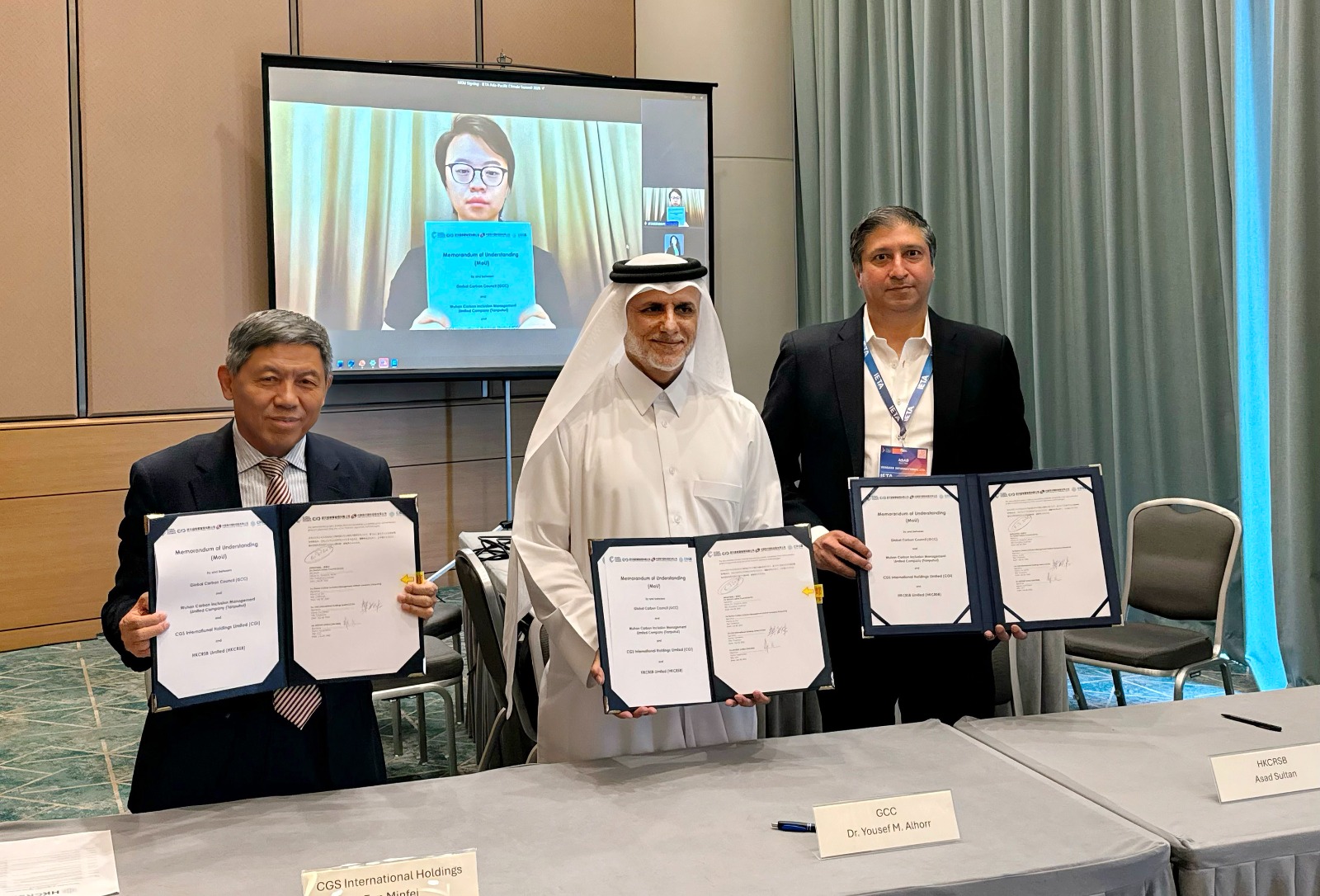
In a defining moment for Qatar’s growing influence in the global climate economy, the Global Carbon Council — an independent, internationally recognised carbon standard established in Qatar — signed a landmark four-party Memorandum of Understanding at the IETA Asia Climate Summit 2026, held from 7 to 9 July at the Hong Kong Convention and Exhibition Centre.
The agreement, signed alongside Wuhan Carbon Inclusion Management Limited Company, CGS International Holdings Limited, and HKCRSB Limited, establishes a comprehensive cooperation framework spanning cross-border carbon methodology recognition, registry coordination, carbon credit registration, carbon finance facilitation, and transparent data exchange.
For Qatar, this is more than a bilateral agreement. It is a statement of global ambition.
A QATARI STANDARD GOING GLOBAL
The Global Carbon Council was founded in Qatar with a clear mission — to develop high-integrity carbon standards that serve the Global South and emerging markets worldwide. Today, that mission is being realised at the highest level of international climate cooperation.
Under the terms of the MoU, GCC-approved methodologies will serve as the international benchmark for urban climate action across participating markets — beginning with Hubei Province in China, with the ambition to scale across Asia and beyond.
The agreement also establishes a cross-border methodology committee to review, recommend, and periodically publish approved methodologies, ensuring alignment with international best practices across both voluntary and compliance carbon markets.
Speaking at the signing, Dr. Yousef M. Alhorr, Founding Chairman of the Global Carbon Council, said the MoU represents a meaningful step toward strengthening cooperation between international carbon standards, domestic implementation systems, and carbon finance platforms.
“By supporting high-integrity methodology development for urban climate action, registry coordination and transparent data exchange, we aim to enhance the credibility, visibility and integrity of carbon market participation — initially in Hubei Province, and contribute to broader climate action across Asia in support of the Paris Agreement,” Dr. Alhorr stated.
WHAT THIS MEANS FOR QATAR’S BUSINESS COMMUNITY
For business leaders, investors, and sustainability professionals across Qatar and the GCC, the significance of this agreement extends well beyond the signing ceremony.
Qatar’s carbon standard is now shaping how emission reductions are measured, verified, and traded across one of the world’s fastest-growing carbon market corridors. As global pressure mounts on corporations to demonstrate credible climate action, having a Qatari institution at the centre of international carbon market architecture positions the country as a trusted bridge between the Global South, the Gulf, and Asia’s rapidly evolving climate economy.
The MoU also opens a pathway toward Article 6.2 of the Paris Agreement — the framework for transferring Internationally Transferred Mitigation Outcomes across borders — with Qatar’s Carbon Market Infrastructure potentially playing a central role in that process.
In a region increasingly focused on energy transition, economic diversification, and sustainability-aligned investment, the Global Carbon Council’s expanding global footprint reinforces Qatar’s credentials as a serious, forward-looking player in the net-zero economy.
LOOKING AHEAD
The four parties will now explore deeper data cooperation between the GCC’s Carbon Market Infrastructure and the Wuhan Carbon Inclusion registry system — including project metadata visibility, synchronisation of registration status, and sharing of cancellation records to enhance traceability and prevent double counting across participating markets.
As carbon markets evolve from policy ambition to practical implementation, the Global Carbon Council’s growing international reach ensures that Qatar remains not just a participant in that conversation — but one of its most trusted architects.