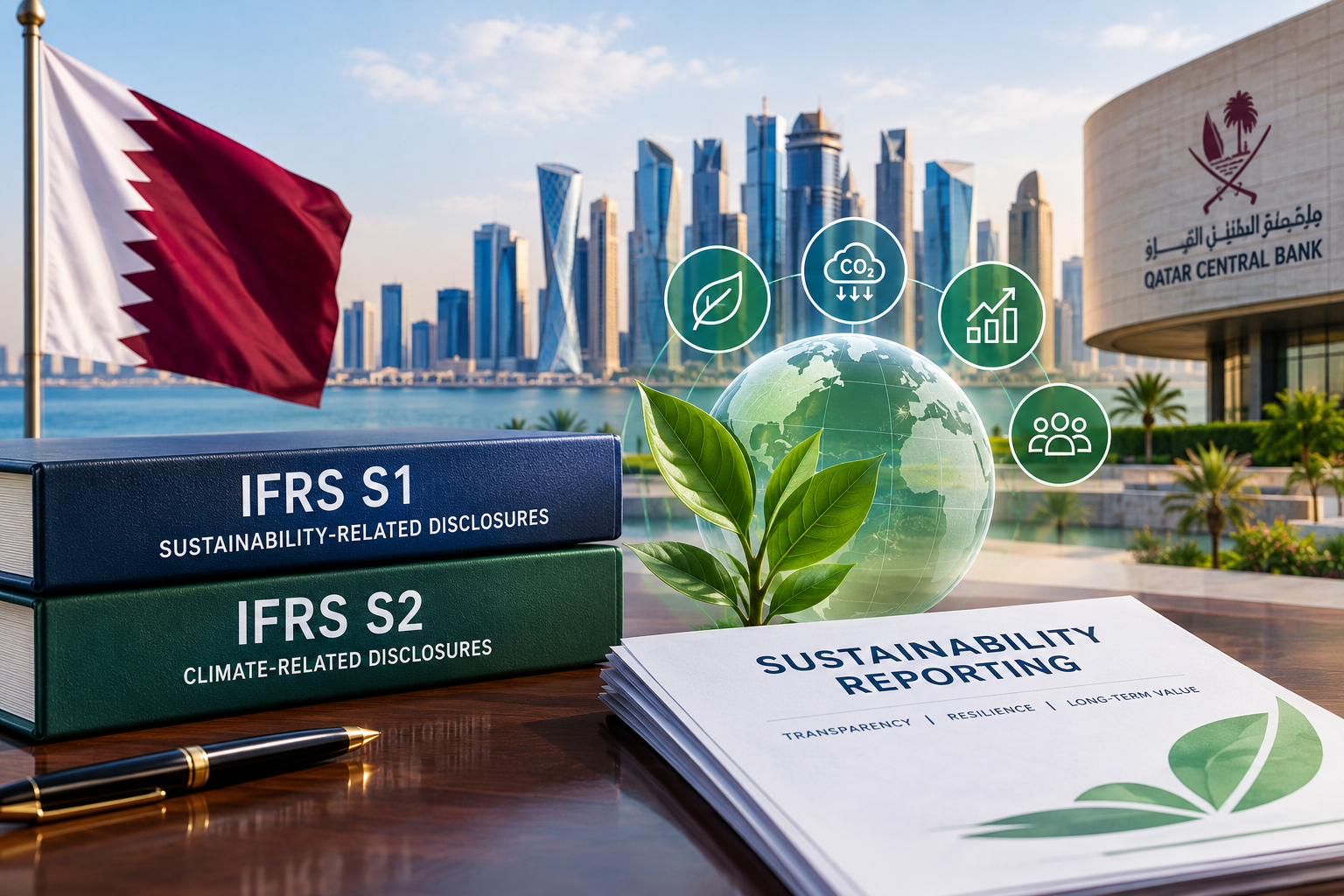

Qatar has positioned itself as one of the earliest movers in the Gulf region’s sustainability reporting landscape, with the Qatar Central Bank mandating the adoption of IFRS S1 and IFRS S2 sustainability disclosure standards for banks and financial institutions effective January 1, 2026.
The Sustainability Reporting Framework from Qatar Central Bank, developed in accordance with the ISSB standards, requires covered entities to disclose their governance approach, strategy, risk management practices, and metrics around climate-related risks and opportunities.
IFRS S1 establishes general requirements for sustainability-related financial disclosures. IFRS S2 meanwhile addresses climate-specific risks and opportunities, including mandatory reporting of absolute Scope 1, Scope 2, and Scope 3 greenhouse gas emissions. Together, IFRS S1 and IFRS S2 provide a comprehensive framework that connects environmental and sustainability performance directly to financial decision-making.
To ensure the regulatory reporting landscape is harmonised across Qatar’s financial system, the Qatar Financial Centre Regulatory Authority (QFCRA) and Qatar Stock Exchange (QSE) have aligned their requirements to IFRS S1 and IFRS S2.
The mandatory adoption of ISSB standards aligns Qatar’s financial sector with the country’s National Vision 2030, which prioritises economic diversification, environmental sustainability, and the transition to a knowledge-based economy.