
Sidra Medicine Launches Qatar’s First Cord Blood Bank
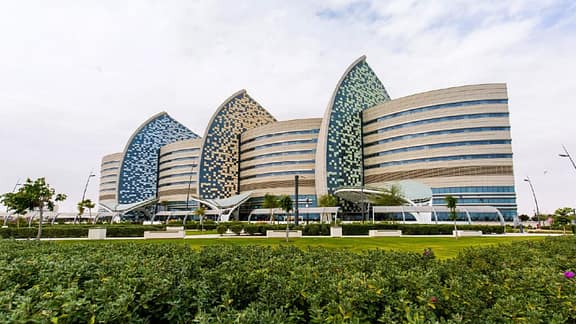
Partnership with CellSave Arabia Expands Reach for Families Across the Country Sidra Medicine, a member of Qatar Foundation, has launched a state-of-the-art cord blood banking service. This is the country’s first local cord blood storage facility and will offer families a unique opportunity to preserve their newborns’ stem cells in Qatar, for potential future medical needs. Cord blood banking is the process of collecting and storing the blood from a newborn’s umbilical cord and placenta after birth. The collection is painless, non-invasive, and risk-free for the mother and baby. Cord blood is rich in hematopoietic stem cells, which have the potential to treat various medical conditions, including certain cancers, blood disorders, and immune system diseases. Prof. Johnny Awwad, Chair of Women’s Services at Sidra Medicine said: “As the only facility in Qatar providing local cord blood storage, Sidra Medicine offers an unparalleled advantage by keeping the samples in the country. This ensures their optimal quality and immediate access when needed most, compared to having them shipped from abroad. Cord blood is increasingly being stored by parents everywhere, who are seeking to preserve their child’s stem cells as they can be crucial for their child or their sibling/s in the future. Our commitment to the latest technology and international standards further guarantees the utmost reliability and peace of mind for families in Qatar.” All the cord blood samples will be sent to Sidra Medicine’s Cord Blood Bank in its Good Manufacturing Practice (GMP) facility, where cryogenic freezing will allow them to be stored securely for over 30 years. Prof. Khalid Fakhro, Chief Research Officer at Sidra Medicine said: “Our cord blood banking service is another successful milestone for our precision medicine strategy. There are over 80 diseases that can be treated using the banked samples including some types of cancers. With this private service now available for maternity patients at Sidra Medicine, we provide parents with the opportunity to safeguard their child’s future health by cryopreserving their stem cells. This is particularly relevant for families with a history of congenital medical issues. The stored stem cells could provide a source for regenerative therapies if their child or other family members experience blood or immune system disorders.” To expand its reach to other families in Qatar, Sidra Medicine signed a Memorandum of Understanding with CellSave Arabia, a leader in stem cell banking services. It is available to any family in the country choosing the joint Sidra Medicine and CellSave Arabia service as their stem cell storage provider regardless of whichever hospital their baby is born in. Dr. Iyabo Tinubu-Karch, Chief Executive Officer of Sidra Medicine said: “This partnership with CellSave Arabia aligns perfectly with Sidra Medicine’s mission to advance healthcare and foster healthier families across Qatar. Thanks to our facilities and CellSave Arabia’s reach, this is the first time that families across the country have an option to have their children’s stem cells stored in the country. Together, we aim to make advanced stem cell processing and storage more accessible, thereby contributing to a more robust healthcare infrastructure in the region.” Alia Abdel-Razeq, COO of CellSave Arabia said at the MoU signing ceremony with Sidra Medicine: “Partnering with Sidra Medicine marks a pivotal step in our commitment to healthcare innovation in Qatar. By utilizing Sidra Medicine’s exceptional facilities and expertise, we can significantly elevate our service offerings, ensuring that families in Qatar have access to vital stem cell banking services that support their future health needs.” Cord blood banking is already available at Sidra Medicine and plans are underway to extend the joint Sidra Medicine and CellSave Arabia service to those who deliver their babies in other hospitals in addition to launching other services including umbilical cord banking, placental tissue banking, amniotic tissue banking, and Mesenchymal Stem Cell (MSC) banking. For further inquiries or assistance about Cord Blood Banking, please download the brochure here or contact us at stemcells@sidra.org.
WCM-Q conference discusses impact of new technologies on medical education
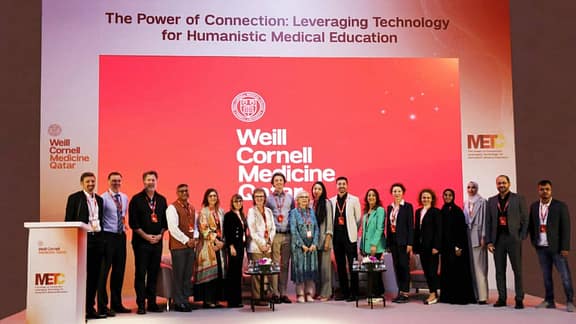
Doha – November 13, 2024: A conference hosted by Weill Cornell Medicine-Qatar (WCM-Q) convened experts in medical education from across the globe to examine the potential for new technologies to enhance the way medicine is taught. The two-day Medical Education Technology Conference (METC) presented thought leaders in medical education from institutions in Qatar, Switzerland, the US and the UK to explore the potential for technologies like artificial intelligence (AI), virtual reality (VR), and augmented reality (AR) to provide personalized learning and immersive training tools for healthcare practitioners. The conference also examined the intersection between technology and humanistic science, and explored ways to ensure that medical education programs cultivate empathy, compassion and creativity in future physicians in the era of AI and rapid technological change. The conference further discussed the impact of emerging technologies on medical ethics and the challenges of ensuring patient privacy, informed consent, and inclusivity in the metaverse. Other features of the conference were two panel discussions, a poster presentation of research projects, Q&A sessions, a series of expert-led presentations, and opportunities for attendees to gain hands-on interactive experiences with technologies such as immersive content creation and VR simulations. Subjects covered by speakers on the first day of the event included precision education and lifelong learning in medicine, AI and medical ethics in education, designing the next generation of learning delivery systems, medical ethics in the metaverse, and the integration of AI into medical education programs to optimize learning outcomes and clinical training. The second day featured presentations on diversity and inclusion in the metaverse, the intersection between art and medicine, and the role of social determinants of health in the age of AI. The second day also offered five workshops, which covered strategies for designing inclusive and accessible virtual environments for patients and healthcare professionals, telling stories in 3D virtual environments using cutting-edge digital tools, utilizing technology to enhance empathy among caregivers, how to create immersive 360-degree videos, and developments in AI-based simulation technologies. One of the many highlights of the event was an artistic performance given by renowned artist and director Abdulaziz Yousef which blended art, AI and virtual reality technology. The event drew participants from all over the world, with healthcare professionals, educators and students in attendance from Qatar, the wider MENA region, the US, Europe, India and elsewhere. Speaking at the conclusion of the event, Dr. Thurayya Arayssi, vice dean for academic and curricular affairs said: “This is a truly exciting time in medicine and medical education as cutting-edge technologies like AI, VR and AR are already revolutionizing the way medicine is practiced, taught and experienced. This conference was a fantastic way to explore how these new technologies can best be implemented to enhance medical education and patient care while simultaneously protecting the rights and safety of patients.” Dr. Javaid Sheikh, dean of WCM-Q, said: “This conference has done a marvelous job of placing new technologies within the context of the humanistic art and science of medicine. Our guiding principle at WCM-Q is to promote the use of emergent technologies to advance world-class healthcare, while also ensuring that the foundational caregiving attributes of compassion, empathy, humility and responsibility to one’s patients are preserved and enhanced by these new developments.” The conference was accredited locally by the Ministry of Public Health’s Department of Healthcare Professions – Accreditation Section and internationally by the Accreditation Council for Continuing Medical Education (ACCME).